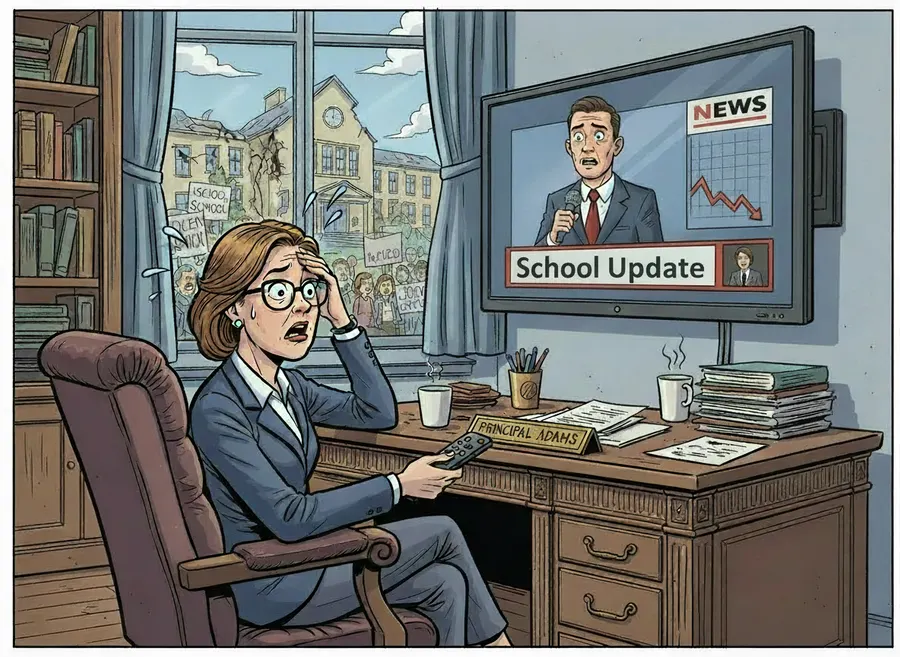

Before I spent my days helping school leaders get ready for reporters, I spent about thirty years as one of those reporters. So let me take you inside a typical newsroom morning. It may change how you feel the next time your phone lights up with a call from the local TV station.
The day actually starts before the morning meeting, and that's often the most stressful part. Reporters are expected to walk in with fresh story ideas for their bosses, and showing up empty-handed is not an option. So the hour before is spent calling sources and scrolling through digital newspapers, community Facebook groups, and social media feeds, looking for something with real pull. That usually means a story with reach beyond a single community, or one that tugs at the heartstrings. It might be a teacher who changed a student's life, or a family whose world was turned upside down by a school decision.
Then comes the meeting itself. Reporters pitch, producers weigh in, and by 10 a.m. a reporter is usually out the door with an assignment. It's not uncommon for a producer to want a live shot at noon, which leaves a couple of hours to line up interviews, gather video, write, edit, and get it on the air. And these days, with stations now streaming, reporters are often expected to tease their stories on air and online throughout the day. A story that once took a full day or more to develop now often has to come together in a few hours or less. And plans can change at any moment as news breaks. A story slated for two minutes of airtime may shrink to twenty seconds, get postponed, or never make air at all.
The first truth: we’re not out to get you. Most of the time, we’re just trying to make interesting TV on a very tight (and in the real world, an unrealistic) deadline.
The second truth is one many school leaders may not want to hear. In a TV market with potentially hundreds of school districts, an average-sized district rarely makes the news for the good things happening every day. You already know this. It takes something remarkable on the positive side or something truly impactful on the negative side. That's why it's so important to frame your story ideas in ways that will resonate with the broader community. It's also why your own social media feed matters so much. A reporter somewhere will periodically scroll through, looking for something that moves them, especially when there's compelling video.
The third truth is about time. When a reporter calls you about a story at 10 a.m., a callback at 10:15 is a gift. A callback at 2:15 is almost useless, because by then the reporter has moved on to something else. (However, don’t use this as an excuse to avoid negative story coverage—it rarely works, and the story may move on without you.) Your most important ability is availability. When a reporter says yes to your pitch, they may need the teacher, the student, and the principal ready within an hour. If you can't pull the key people together quickly, the story goes to someone who can.
The fourth truth: when the news is difficult, a written statement read on air rarely sounds as good as you think. Read by an anchor over video showing the outside of your school, it can come across as cold and distant. A leader who shows up for two minutes of honest conversation almost always does better.
And the final truth: reporters remember who helps them. The principal who called back quickly or made a great story easy to cover earns real goodwill with reporters. That never guarantees kind coverage later, but it will guarantee a fair hearing and the reporter’s ear the next time you have something good to share.
So when a reporter calls, try asking one simple question first: "What's your deadline?" It shows you understand their world, and it tells you exactly how much time you have.
Because the person holding the microphone is usually just someone with a deadline, hoping you'll pick up the phone.